
 中文简体
中文简体
 English


Wanghe Industrial Park, Qixian Street, Keqiao District, Shaoxing City, Zhejiang Province, China.
This comprehensive analysis delves into the material science, manufacturing processes, and specific technical specifications that confirm polyester embroidery thread as the professional standard. We will explore its chemical advantages over traditional materials, the critical role of the polyester embroidery thread manufacturer in ensuring quality, and the nuanced differences between various denier counts that dictate application suitability.
The Chemical and Physical Superiority of Polyester Embroidery Thread
Polyester, or polyethylene terephthalate (PET), is a synthetic polymer valued globally for its inherent strength and stability. When extruded into fine fibers for embroidery, these properties are transferred directly, creating a thread with distinct advantages over natural and semi-synthetic counterparts.
1. Exceptional Tensile Strength
One of the most critical factors in high-speed embroidery is the thread’s tensile strength—its resistance to breaking under tension. Polyester embroidery thread exhibits significantly higher tensile strength than rayon or even many cotton threads of comparable thickness. This robustness is vital in industrial settings where machines operate at speeds exceeding 1,000 stitches per minute. Reduced breakage translates directly into increased efficiency, fewer machine stoppages, and improved stitch quality. The structural integrity of the thread allows it to endure the friction and rapid movements through the needle eye and tension discs without fraying or snapping.
2. Unrivaled Colorfastness
Color retention is a major consideration, particularly for commercial apparel and items that will undergo frequent washing or exposure to harsh conditions. Polyester embroidery thread boasts near-perfect colorfastness. Unlike rayon, which can be susceptible to fading, especially when exposed to strong detergents or high temperatures, the dyes used in polyester penetrate the polymer matrix deeply and form strong chemical bonds. Crucially, high-quality polyester embroidery thread is highly resistant to chlorine bleach. This resistance is a non-negotiable requirement for items like medical scrubs, restaurant linens, or uniforms that must be sterilized frequently. The embroidery maintains its vibrant, intended hue long after the fabric itself may show signs of wear.
3. Low Fuzz and High Abrasion Resistance
The surface of polyester embroidery thread is naturally slick and smooth, resulting in lower fuzz buildup during stitching. Low fuzz minimizes needle friction, which keeps the needle cooler and reduces the chance of melting or breaking. This inherent abrasion resistance also contributes to the longevity of the finished design, ensuring that the stitches themselves resist wear and thinning even after thousands of rubs against the surrounding fabric.
Manufacturing Precision: The Role of the Polyester Embroidery Thread Manufacturer
The quality of the final thread is entirely dependent on the precision and quality control standards employed by the polyester embroidery thread manufacturer. The transition from raw polymer chips to a finished spool involves complex, tightly controlled processes: spinning, twisting, dyeing, and lubrication. The performance characteristics of a premium thread are forged in the polyester embroidery thread factory.
A. Spinning and Plying
The process begins with melting the PET polymer and extruding it through spinnerets to form continuous filament fibers. Unlike spun threads (like cotton, which are made of short, discontinuous fibers twisted together), modern polyester embroidery thread is almost always a continuous filament structure. This continuous nature is what gives the thread its superior strength and uniformity. These filaments are then twisted together—a process called plying—to create the final thread thickness and structure. The consistency of this twist is monitored rigorously by the polyester embroidery thread manufacturer to prevent weak spots or loops that could cause tension problems in the embroidery machine.
B. High-Pressure Dyeing
Dyeing polyester is a high-temperature, high-pressure process that ensures deep color saturation and permanence, a method inherently superior to the more superficial dyeing of rayon. The polyester embroidery thread factory uses advanced color spectrometry to match specific thread colors to industry standards (like Pantone), guaranteeing lot-to-lot color consistency. This precision is vital for large commercial orders where thousands of garments must feature identical branding colors.
C. The Role of Lubrication
A hallmark of a high-quality polyester embroidery thread manufacturer is the application of a superior lubricant finish. Before the thread is spooled, it is treated with a specialized oil or wax finish. This lubrication is not just for ease of unwinding; it is crucial for heat management. When a needle moves rapidly through dense fabric, friction generates extreme heat. The lubricant dissipates this heat, preventing the thread from melting and fusing to the needle or breaking. A poorly lubricated thread is a primary cause of production delays, emphasizing why choosing a thread from a reputable polyester embroidery thread factory is essential for professional outcomes.
Understanding Denier and Ply: Technical Specifications of Polyester Embroidery Thread
To fully appreciate the versatility of polyester embroidery thread, one must understand the denier and ply system used by the polyester embroidery thread manufacturer to specify thread thickness. Denier (D) is a measure of linear mass density: the weight in grams of 9,000 meters of a single filament. Ply (P) refers to the number of filaments twisted together. The standard notation, D/P, therefore, defines the thread's final dimensions and, critically, its application.
The most common thread size in the industry is 40 weight, but the denier/ply specification is more technically accurate. Here is a breakdown of the three key types: 120D/2, 75D/2, and 150D/2 polyester embroidery thread.
1. 120D/2 Polyester Embroidery Thread (Equivalent to 40 Weight)
Specification: This is the industry standard and the workhorse size for most general embroidery applications. It signifies a thread where two strands (plies) of 120 denier filament are twisted together. This results in a thread that is thick enough to offer excellent coverage and visual impact but thin enough to work smoothly on high-speed machines.
Application: Ideal for general logos, text, medium-density fill areas, and standard decorative designs on apparel, caps, and outerwear. Its balanced thickness ensures that the finished embroidery feels neither too bulky nor too thin, providing a durable and aesthetically pleasing result.
Performance Profile: Due to its optimal size, 120D/2 polyester embroidery thread offers the best balance of speed and coverage. It requires minimal adjustment of needle size (typically a size 75/11 or 80/12) and tension settings on industrial embroidery machines, making it the default choice for high-volume polyester embroidery thread factory production.
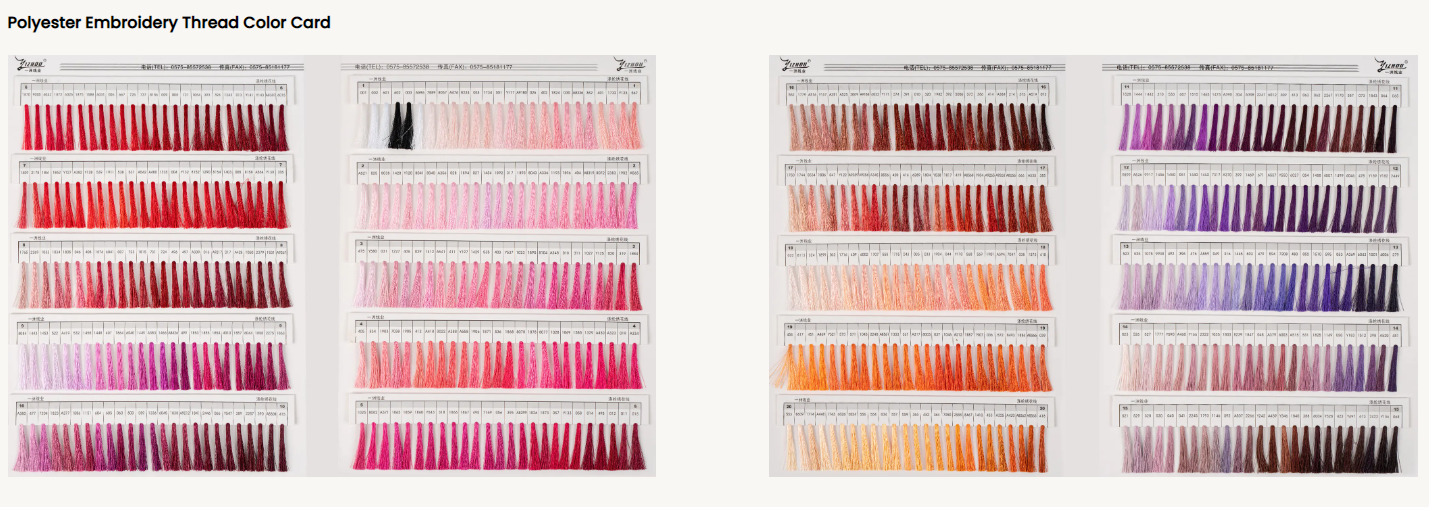
2. 75D/2 Polyester Embroidery Thread (Equivalent to 60 Weight)
Specification: This thread is significantly finer than the standard 120D/2. It consists of two strands of 75 denier filament. The smaller diameter means it requires higher density stitching to achieve the same visual coverage as the 120D/2.
Application: This size is used for highly detailed, small lettering, fine outlining, intricate details (like facial features or small logos), and for embroidery on lightweight or sheer fabrics. When embroidering fine fabrics, a finer thread minimizes the risk of puckering or distortion caused by dense stitching. It is also used in small-scale quilting applications where the thread should be less conspicuous.
Performance Profile: Using 75D/2 polyester embroidery thread requires specialized fine needles (typically size 65/9 or 70/10) and potentially lower machine speeds due to the delicacy of the thread. While slower, it allows the polyester embroidery thread manufacturer to create a product that delivers the fine resolution and detailed fidelity impossible to achieve with a standard 40 weight thread.
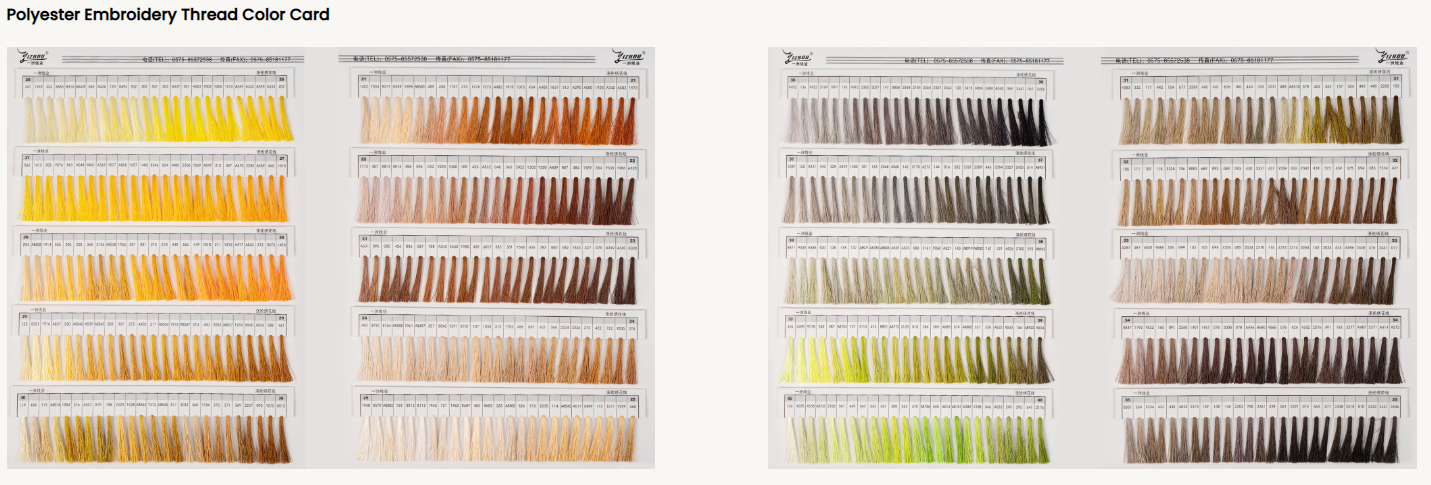
3. 150D/2 Polyester Embroidery Thread (Equivalent to 30 Weight)
Specification: This is a heavier, thicker thread, created by twisting two strands of 150 denier filament. It provides the boldest, most robust appearance among the three.
Application: Primarily used when maximum visual impact and quick coverage are required. This includes large areas of fill stitching on heavy fabrics (like denim, leather, or thick fleece), puff embroidery (where the thread must be thick enough to cover foam), and bold, block lettering. Its thickness significantly reduces the necessary stitch count, saving production time on large-scale designs.
Performance Profile: Due to its bulk, 150D/2 polyester embroidery thread demands larger needles (typically size 90/14 or 100/16) and often requires slightly reduced machine speeds to ensure the needle eye can accommodate the thicker thread without excessive friction. When properly managed, this thread delivers a pronounced, textured, and highly durable finished result, making it the choice when an aggressive, tactile design element is desired.
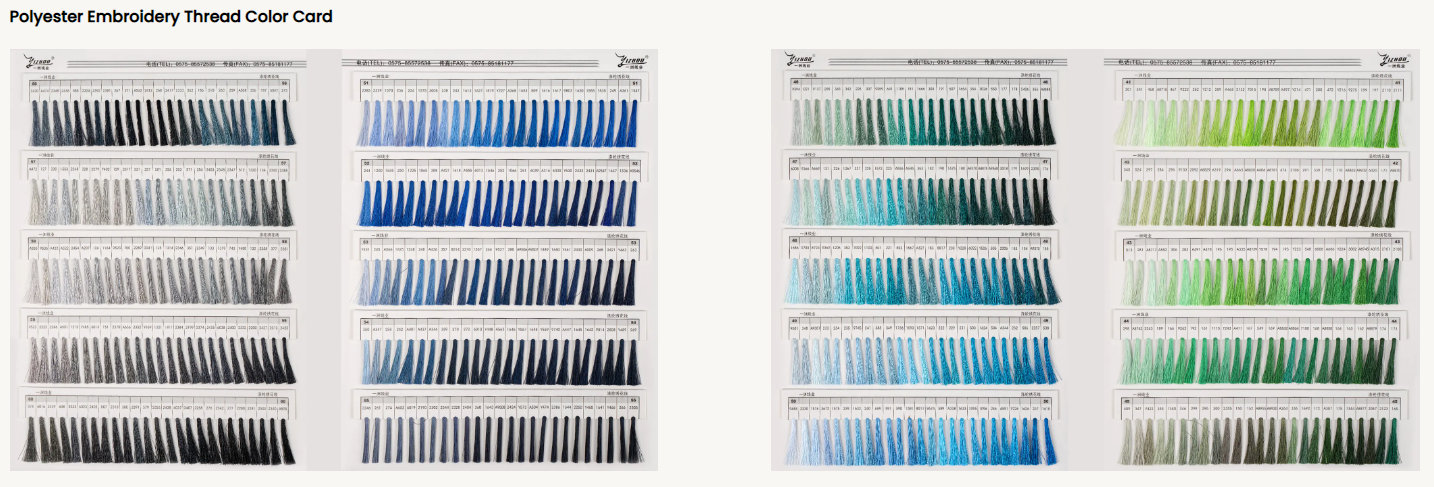
Operational Performance: Speed, Stability, and Machine Compatibility
The performance of polyester embroidery thread on high-speed industrial equipment is where its engineering excellence truly shines. The consistent diameter, uniformity of twist, and specialized lubrication (as ensured by the polyester embroidery thread manufacturer) work synergistically to provide unparalleled operational stability.
The thread’s stability minimizes loop formation and twist-related issues that plague lesser threads. Stable tension means the stitches form consistently across the entire embroidered area, leading to uniform shine and stitch density. This reliability is vital for the polyester embroidery thread factory environment, where machines run for hours unattended. Fewer interruptions mean higher throughput and predictable quality control. Furthermore, polyester’s inherent low stretch compared to rayon makes it less prone to distortion during stitching, resulting in sharper, more precisely defined edges in the finished design.
The Aesthetic Dimension: Luster, Finish, and Application Versatility
Early generations of polyester embroidery thread were sometimes criticized for having a duller finish than rayon. However, modern manufacturing techniques have largely eliminated this difference. Today’s high-quality polyester threads are produced with a tri-lobal or multi-lobal cross-section, which dramatically increases the surface area available to reflect light. This structure gives the thread a brilliant, high-sheen luster that rivals rayon while retaining the strength of the synthetic fiber.
This aesthetic versatility, combined with its operational stability, makes polyester embroidery thread suitable for nearly every application:
Apparel: Corporate logos, fashion embroidery, and customized garments.
Home Textiles: Towels, bedding, and decorative cushions (where washability is paramount).
Outdoor and Technical Gear: Patches on backpacks, tents, or safety vests (where UV and weather resistance is necessary).
Durability and Longevity: The Wash Test Advantage
The true measure of any embroidery thread's quality is its resilience over time and exposure. The durability of polyester embroidery thread is demonstrably superior, particularly under harsh laundering conditions.
Polyester’s inherent resistance to moisture absorption means it dries quickly and is highly resilient to degradation from microbial growth, mold, and mildew—a significant advantage for products used in humid environments. The chlorine bleach resistance is a major selling point in the institutional and medical sectors. While rayon can suffer immediate color loss or structural damage from exposure to chlorine, high-quality polyester embroidery thread remains largely unaffected, making it the only viable choice for garments requiring rigorous sanitation. The structural integrity of the thread ensures the embroidered design remains intact, resisting the fraying and distortion often seen in less durable fibers after dozens of washing cycles.
The Modern Standard for Reliability
The question "Is polyester embroidery thread good for embroidery?" is answered comprehensively through an analysis of its technical profile. Thanks to the sophisticated techniques employed by the polyester embroidery thread manufacturer and the specialized production capabilities within the polyester embroidery thread factory, modern polyester thread offers an unparalleled combination of chemical resilience, structural strength, aesthetic brilliance, and operational stability. From the robust coverage of the 150D/2 thread on heavy textiles to the fine detail enabled by the 75D/2 thread, polyester is the superior choice for high-speed, high-demand, and high-durability embroidery applications, establishing itself as the undisputed modern standard in decorative textile technology.